Ever since their hella successful ICO, the crypto experts at VapeCoinIO have
put developers first with their simple, intuitive, and, most importantly,
secure API. Once you’ve created your account and set up your wallet, you can
access it programmatically using your VapeID by sending a GET request to
/api/login?key=<HASH> where <HASH> is your VapeID. Your wallet is
transferred to you over TLS, so don’t worry—it’s really, really secure. In
fact, it’s so secure that the founder and CEO of VapeCoinIO uses the API for his
personal Brainwallet.
One of your contacts is a site-reliability engineer at VapeCoinIO. He has
obtained a PCAP of a TLS session with a client originating from an IP he
suspects to be used by CEO’s personal laptop. Perhaps he accessed his wallet!
Can you find a way to recover its contents?
As the problem description says, the first thing we notice in the PCAP is that
the data is transferred exclusively over a TLS connection. Thus the first thing
we need to look for is something amiss in the TLS exchange such as the use of a
weak cipher.
We can see in the PCAP that the TLS connection is using:
TLS_DHE_RSA_WITH_AES_128_GCM_SHA256
DHE stands for “Diffie-Hellman ephemeral” which is where the RSA key is used to
sign the server’s Diffie-Hellman public number to provide authenticity and
every TLS session uses a new set of public numbers.
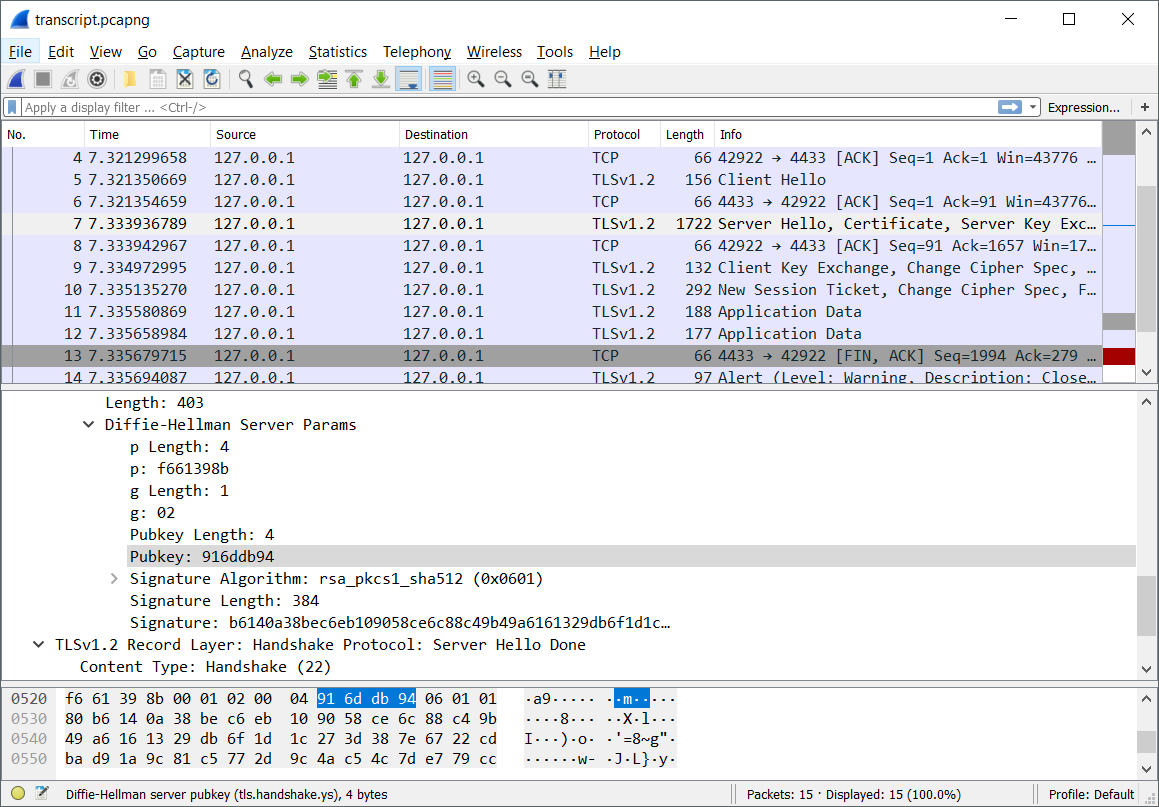
Looking at the Diffie-Hellman numbers in wireshark, we notice something very
interesting:
Those numbers look absolutely tiny! Diffie-Hellman’s security is based on the
difficulty of the Discrete Logarithm
problem. Ordinarily the p (prime) for DH is a 2048 bit number, here it’s
an abysmal 32 bits making it trivial to compute discrete logarithms
on. SageMath has several algorithms built in to
compute discrete logs so we wrote up a quick script to recover the client’s
secret number.
The client secret is then enough to compute the shared secret. This is known as
the pre-master secret in
TLS terms which is all wireshark needs to decrypt TLS traffic.
In order to let Wireshark utilize this, it needs a file mapping TLS sessions to
the master or pre-master secrets. So we made a file called keylogfile.txt
containing:
PMS stands for Pre-Master Secret and the giant number in the middle is the
client random, sent as part of the Client Hello packet which is what
wireshark uses to map the PMS to the right TLS session.
(Note: wireshark displays the timestamp and random bytes seperately if you
expand the Random portion in the TLS packet, the client random is the
timestamp and random bytes together.)
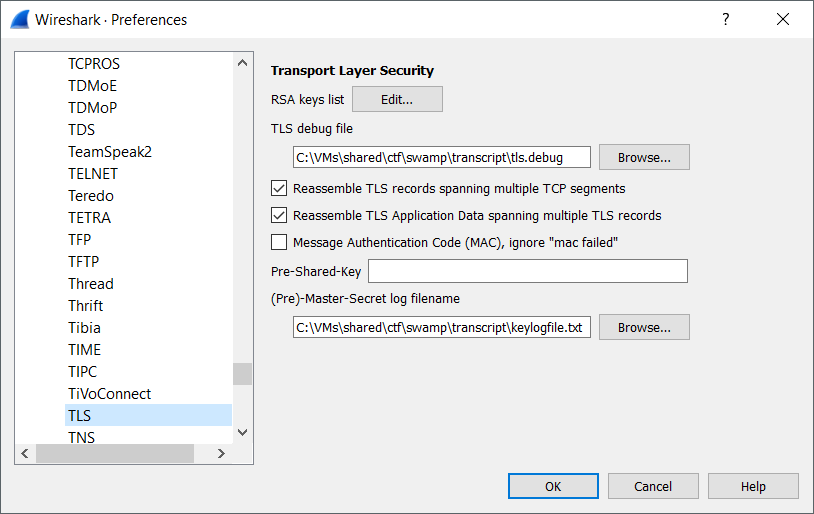
We set up Wireshark’s TLS protocol settings to use the log file:
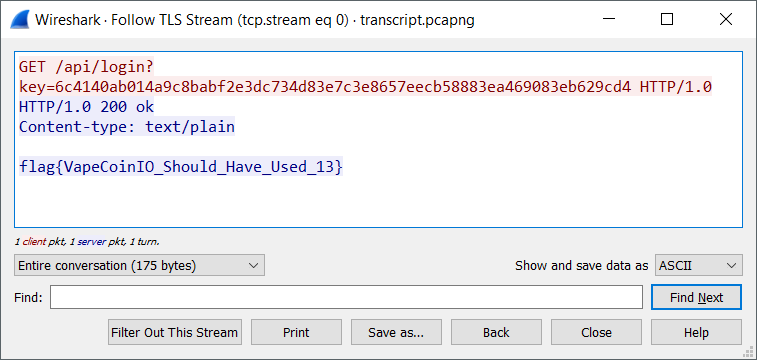
and boom, follow the TLS stream in Wireshark for the flag:
A lesson on data structures, networking protocols, data sanitization and disclosure
Around 2 years ago, I was enthusiastically working on Spigot and Bukkit along with a couple
of fairly popular plugins. During my poking around within the networking internals of
Minecraft, I came across a fairly substantial
problem that allowed anyone to send certain malformed packets and crash a server by
running it out of memory.
Following the defacto standard procedure, I responsibly and privately disclosed the
problem to Mojang on 10th July, 2013. That’s nearly 2 years ago. I asked for updates
in one month intervals over the course of 3 months and was ignored or given highly
unsatisfactory responses. I kept my hopes up that the problem would be patched and checked
the source code on new releases whenever I could.
The version of the game when the vulnerability was reported was 1.6.2, the game is now on
version 1.8.3. That’s right, 2 major versions and dozens of minor versions and a critical
vulnerability that allows you to crash any server, and starve the actual machines of CPU and
memory was allowed to exist.
The technical details
The minecraft protocol enables the exchange of information about what an inventory slot contains.
This allows you to, for example, get the items in your hotbar when you log in. Items in minecraft
also contain a feature that allows them to store arbitary metadata (used for enhancements, books etc).
This metadata is stored in a format known as NBT. The NBT format is essentially
like JSON but in binary form. This allows it to store complex data structures with nesting and the like.
For example, the NBT metadata (known as a tag) for a book might look something like this
tag:{author:"ammar2",title:"Kitteh",pages:["Kitties are cute","I like kitties"]}
The vulnerability stems from the fact that the client is allowed to send the server
information about certain slots. This, coupled with the NBT format’s nesting allows us to
craft a packet that is incredibly complex for the server to deserialize but trivial for
us to generate.
In my case, I chose to create lists within lists, down to five levels. This is a json representation
of what it looks like.
The root of the object, rekt, contains 300 lists. Each list has a list with 10 sublists, and each of
those sublists has 10 of their own, up until 5 levels of recursion. That’s a total of 10^5 * 300 = 30,000,000 lists.
And this isn’t even the theoretical maximum for this attack. Just the nbt data for this payload is 26.6 megabytes. But luckily
minecraft implements a way to compress large packets, lucky us! zlib shrinks down our
evil data to a mere 39 kilobytes.
Note: in previous versions of minecraft, there was no protocol wide compression for big packets.
Previously, NBT was sent compressed with gzip and prefixed with a signed short of its length, which reduced our maximum payload
size to 2^15 - 1. Now that the length is a varint capable of storing integers up to 2^28, our potential for attack has increased significantly. (for the more technically minded people, we fill the list up with TAG_ENDs, which aren’t accounted for by the accumulator Mojang attempted to implement to fix this)
When the server will decompress our data, it’ll have 27 megs in a buffer somewhere in memory, but that isn’t the bit
that’ll kill it. When it attempts to parse it into NBT, it’ll create java representations of the objects meaning
suddenly, the sever is having to create several million java objects including ArrayLists. This runs the server
out of memory and causes tremendous cpu load.
The fix for this vulnerability isn’t exactly that hard, the client should never really send a data structure
as complex as NBT of arbitrary size and if it must, some form of recursion and size limits should be implemented.
These were the fixes that I recommended to Mojang 2 years ago.
Proof of concept
A proof of concept of this exploit can be seen here on my Github repo.
The code to generate the posioned nbt can be seen in start.py. The code has been tested under python 2.7, once
you have connected to a server simply enter exploit in the command line and the packet will be sent to the server.
Disclosure
I thought a lot before writing this post, on the one hand I don’t want to expose thousands of servers to a major
vulnerability, yet on the other hand Mojang has failed to act upon it. Mojang is no longer a small indie company
making a little indie game, their software is used by thousands of servers, hundreds of thousands of people play on
servers running their software at any given time. They have a responsibility to fix and properly work out problems
like this. In addition, it should be noted that giving condescending responses to white hats who are responsibly
disclosing vulnerabilities and trying to improve a product they enjoy is a sure fire way to get developers dis-interested
the next time they come across a bug like this.
Timeline
28th July, 2013: First contact with mojang employee about the issue, vulnerability disclosed and proof of concept
provided.
19th August, 2013: Second time asking about fix, response given that its being worked on.
24th September, 2013: Third contact with employee, told that the problem has been delegated.
25th October, 2013: Fourth time I attempted to contact employee, ignored.
27th October, 2013: Another attempt to contact, ignored again. (at this point, I patiently waited for a fix)
In retrospect, yes, I should have given them a final warning sometime recently before this but I just expected to be shot down again
Update: With the release of this full disclosure I have actually made contact with mojang and they are working to fix the issue. Apparently the initial fix they tried failed which indicates a lack of proper testing.
Update 2: The exact problem that caused this bug to go unpatched has been identified. Mojang attempted to implement a fix for this problem, however they did not test their fix against the proof of concept I provided, which still crashed the server perfectly fine. This, in combination with ignoring me when I asked for status updates twice led me to believe that Mojang had attempted no fix. In retrospect, a final warning before this full disclosure more recently was propbably in order. A combination of mis-communication and lack of testing led to this situation today, hopefully it can be a good learning experience.
Update 3: This problem has been patched as of minecraft version 1.8.4
I’m happy to see that multiple other security issues have also been fixed. Once again, I feel better communication would have easily alleviated this problem. Keeping me in the loop and not ignoring me, in addition to proper testing would have easily led to this exploit being fixed long ago.
Edit: In regards to the statements that I never filed a report on their bug tracker, I’d just like to point out that nobody pointed me towards the tracker when I reported the issue, I wasn’t asked to make a ticket or told that I could follow the progress of the report on x-ticket.
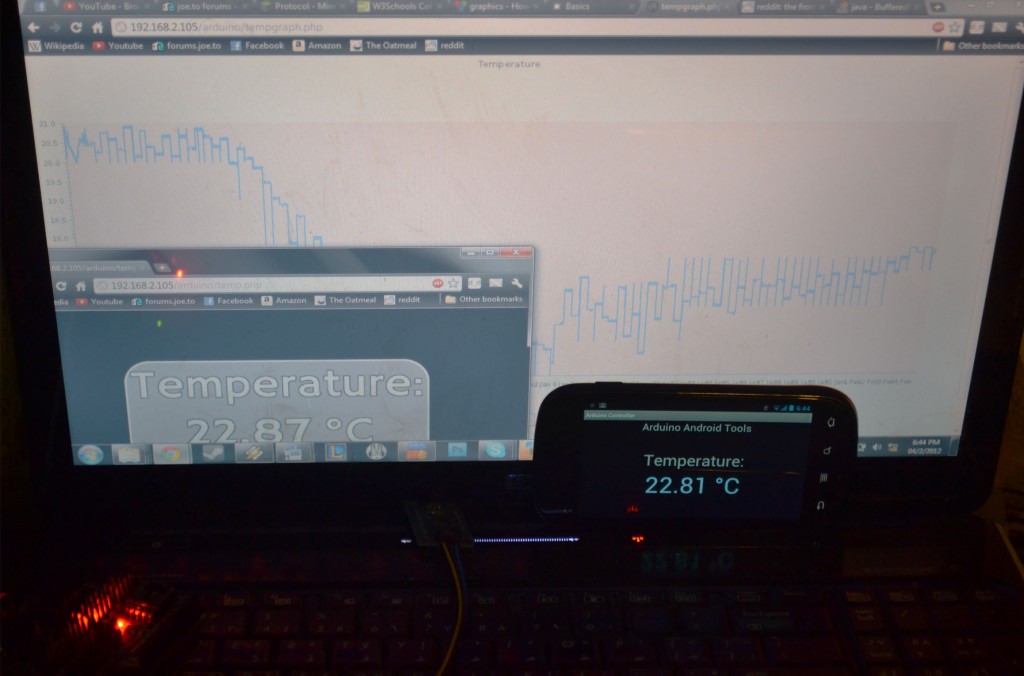
Custom API being used by a javascript web page, android and php graphing program. Apologies for the slight out of sync-ness, the web page polls temperature faster causing the one on the phone and page to be different.
I was always really interested in making new projects for my arduino, the first of which was an LED music visualizer. The problem here was that arduinos aren't really popular in Pakistan, I had to get my current duemillenove shipped in from China thus getting an internet shield would be very difficult. One fine day I started thinking and said to myself, hey I nave a dedicated home server why not just hook up the arduino to that and write a program on the server to read that data through serial and use it somehow. Initially it was designed just to be able to read the current temperature, graphing was added in later.
Here is how it works:
The first part of the process is an arduino which has a DS18B20 Temperature Sensor attatched to it. Using serial communication, it sends out temperature readings to my dedicated home server.
The next part is a python script running in an infinite loop, it reads the values from the serial port and then proceeds to put them in a MySQL table, this occurs once every 2 minutes.
importMySQLdbimporttimeimportserialimportsysconn=MySQLdb.connect(host="localhost",user="derp",passwd="murp",db="tempdata")whileTrue:timestamp=int(time.time())ser=serial.Serial('/dev/ttyUSB0');ser.openlinebeep=ser.readline()line=ser.readline()cursor=conn.cursor()cursor.execute("""INSERT INTO Data(Temperature, Time)
VALUES(%s, %s)""",(line,timestamp,))ser.closeprinttimestampprintlinetime.sleep(120)
The final stage is a php script using jpgraph to plot the data from the mysql table.
<?phprequire_once('jpgraph/src/jpgraph.php');require_once('jpgraph/src/jpgraph_line.php');$link=mysql_connect('localhost','derp','hurp');if(!$link){die('Could not connect: '.mysql_error());}mysql_select_db("tempdata",$link);$query=mysql_query("SELECT Temperature from Data");$i=0;while($row=mysql_fetch_array($query)){$holder=(float)$row[0];$temparray[$i]=$holder;$i++;}$query2=mysql_query("SELECT Time from Data");$p=0;//This part of the script is used to get the dates at the bottomwhile($row=mysql_fetch_array($query2)){$rowint=(int)$row[0];$kitteh=date("G:i",$rowint);if($kitteh=="0:01"||$kitteh=="0:02"||$kitteh=="0:00"||$kitteh=="0:03"){$datesarray[$p]=date("j M",$rowint);}else{$datesarray[$p]="";}$p++;}$graph=newGraph(1300,700);$graph->SetScale("textlin");$theme_class=newUniversalTheme;$graph->SetTheme($theme_class);$graph->title->Set('Temperature');$graph->SetBox(false);$graph->img->SetAntiAliasing();$graph->yaxis->HideZeroLabel();$graph->yaxis->HideLine(false);$graph->yaxis->HideTicks(false,false);$graph->xgrid->Show();$graph->xgrid->SetLineStyle("solid");$graph->xaxis->SetTickLabels($datesarray);$graph->xgrid->SetColor('#E3E3E3');// Create the first line$p1=newLinePlot($temparray);//$p1 = new LinePlot($newx);$graph->Add($p1);$p1->SetColor("#6495ED");$p1->SetLegend('Temperature');$graph->legend->SetFrameWeight(1);// Output line$graph->Stroke();?>